
A tenant moves out, leaving $1,800 in real carpet and drywall damage. The owner photographs all of it, subtracts it from the deposit, and feels on solid ground. Then it comes apart over a bank account and two signatures from move-in day — the damage never enters the conversation.
In Lexington-Fayette County, your rentals run under Kentucky's Uniform Residential Landlord and Tenant Act, and it asks two things of every deposit: hold it in a separate account the tenant is told about, and get the unit's condition signed by both sides at move-in and at move-out. A landlord who does neither forfeits the right to keep a single dollar — no matter how real the damage (KRS 383.580). And even short of that, the signed move-in list is the only proof of which damage the tenant caused. Without it, an $1,800 deduction is your word against theirs.
That's the part of this job you never see. What decides a deposit case happens months before anyone argues about it — at lease signing, in how the account was set up, on a condition report two people signed and forgot. None of it shows up between rent checks — it just quietly gets handled.
Deposits are only one clock. Kentucky puts a specific number of days on nearly every move a landlord makes, and the wrong one — a 7-day notice where the law wants 14 — restarts the process and hands the other side its technicality.
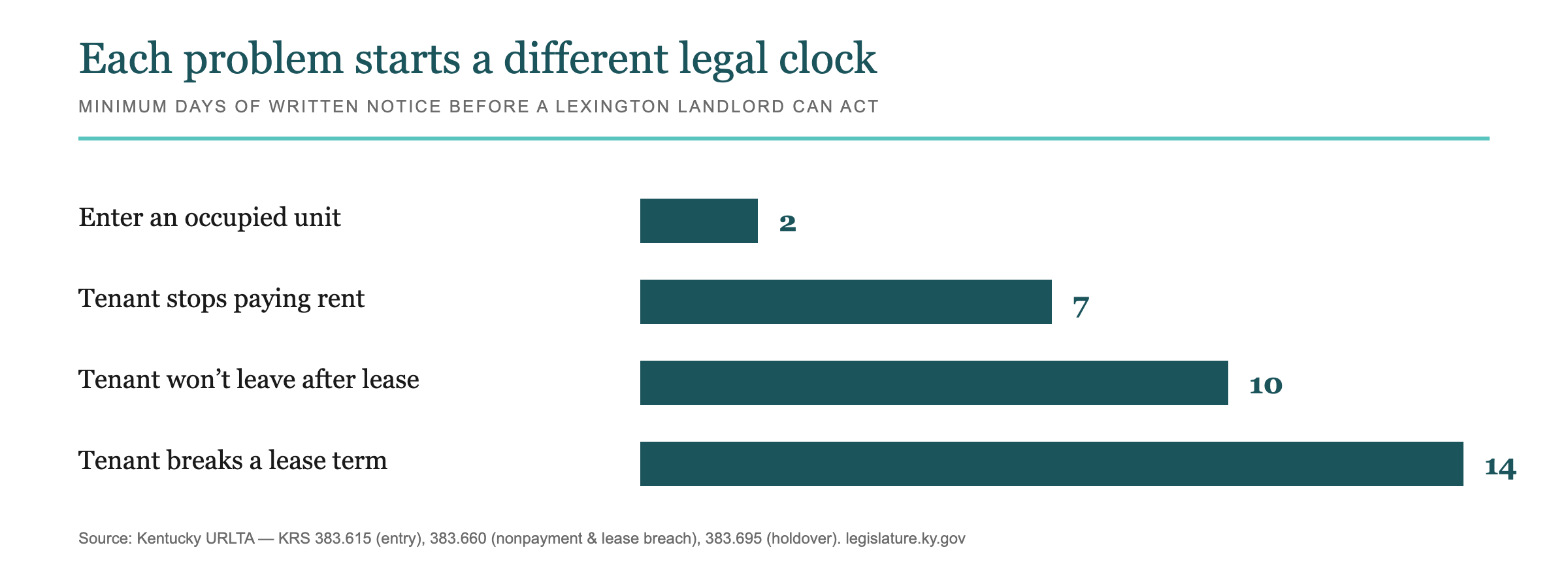
A few days short on a notice can get the whole case dismissed. We track every date so you never have to.
Also worth knowing
— Squatter removal got easier. Since June 27, 2025, you can have law enforcement remove someone occupying your property who was never a tenant — no formal eviction, just a written petition (HB 10).
— Two days' notice before you enter. Showings, inspections, repairs — non-emergency entry needs two days' written notice (KRS 383.615), the easiest rule to break by accident.
— Watch the timing after a complaint. Raise rent or evict within a year of a habitability complaint and Kentucky can presume retaliation (KRS 383.705) — unless the complaint came after your notice. We keep the sequence clean.
— Name the manager in writing. The tenant must be told, in writing, who manages the unit and who accepts legal notices; skip it and whoever signed for the owner gets served in their place (KRS 383.585).
— Skip the noise. Two 2026 bills — capping screening fees, and tenant first-dibs to buy — died in committee. Nothing changed, nothing to do.
Bring this to your next conversation with us
1. Is the deposit on my property in its own account, and do we have a signed move-in condition report on file for it?
2. If a tenant of mine falls behind or breaks the lease, which notice clock are we on — and when does it run out?
3. If someone ever occupied one of my units without a lease, would we use the new squatter-removal petition or a formal eviction?
Do this month
— Ask us for the signed move-in condition report on any property you own — your proof the day a deposit is disputed.
— Self-managing on the side? Move that deposit into its own account this week, and put the unit's condition in writing before the next tenant signs.
— Send us the lease question you've been sitting on. One fix now beats one technicality later.
Reply with the one compliance question you've always wondered about. We read every one, and we answer them. — Nathan Peel P.S. Fifteen years in, the deposit rule is still the one I watch cost good landlords the most — and it is almost always someone who did right by their tenant and just missed a signature back at move-in. If one of these has ever bitten you, I'd genuinely like to hear how it played out. — Nathan |
Sources: KRS 383.580 — Security deposits · KRS 383.660 — Termination for nonpayment or breach · KRS 383.615 — Landlord's right of entry · KRS 383.585 — Disclosure of manager and owner · HB 10 (2025) — Removal of unlawful occupants
This newsletter is provided by Home Forward for general educational purposes for property owners and is not legal advice. Kentucky landlord-tenant law applies differently to different properties and situations; statutes and effective dates reflect publicly available information as of the publication date and may change. For guidance on a specific property or dispute, contact us or a Kentucky attorney. To unsubscribe, reply with "unsubscribe" in the subject line.